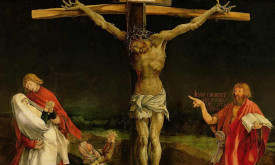
SOME PEOPLE SAY that true salvation is not to be found in the Old Testament. However, a closer look at the Book of Job shows that Job indeed seems to understand—at least in a primitive way—all the elements of salvation. He understands sacrifice and advocacy before a judge. Job says to God, “Why do you not pardon my offenses and forgive my sins?” (v. 7:21). Then, further, “Surely then you will count my steps but not keep track of my sin. My offenses will be sealed up in a bag; you will cover over my sin.” (v. 14:16). Finally, he goes on to proclaim to his friends (and to himself), “Even now my witness is in heaven; my advocate is on high. My intercessor is my friend as my eyes pour out tears to God; on behalf of a man he pleads with God as one pleads for a friend.” (v. 16:18-21)
At the start of the book, he shows that he understands the concept of unintentional sin, reflecting the Levitical law of restitution for accidental sins. “When a period of feasting had run its course, Job would make arrangements for [his children] to be purified. Early in the morning, he would sacrifice a burnt offering for each of them, thinking, “Perhaps my children have sinned and cursed God in their hearts.”” (v. 1:4)
For Bildad, however, in his usually stern manner, there seems to be no way of salvation at all. “How then can a mortal be righteous before God? How can one born of woman be pure? If even the moon is not bright and the stars are not pure in his eyes, how much less a mortal, who is but a maggot—a human being, who is only a worm!” (v. 25:4-6) Besides his low view of the celestial bodies, he obviously does not hold Job’s—or the Psalmist’s—high view of man in God’s creation order: “You have made them a little lower than the angels and crowned them with glory and honor.” (Psalms 8:5)
Righteous Before God vs Righteous Before Men
Though not directly speaking to the nature of salvation, Job does point out that God’s judgment and man’s judgment are quite different (19:2 and following): “How long will you torment me and crush me with words? Ten times now you have reproached me; shamelessly you attack me. If it is true I have gone astray, my errors remain my concern alone. If indeed you would exalt yourselves above me and use my humiliation against me, then know that God has wronged me and drawn his net around me.”
These concepts are typical and similar to those throughout the Old Testament. But Job, whether through special revelation or the intensity of his experience, goes further.
Uniqueness of Job’s Perspective
Job’s struggle with the relationship between suffering and righteousness challenged the simplistic retribution theology often found in the Old Testament. This is the most personal recorded incident where a faithful person experiences such suffering (a distant second being the Apostle Paul, but he was at least told—through Ananias—“how many things he must suffer for My name’s sake” (Acts 9:15-16)
Job expressed a strong belief in a personal Redeemer, using a Hebrew word that can be translated in various ways, including: redeemer, avenger, vindicator, or protector. This concept goes beyond the typical Old Testament usage, pointing more directly to a singular, personal messiah.
Job’s hope was in an actual physical resurrection and vindication, a concept not as explicitly stated in many other Old Testament books, other than Isaiah (26:19) and Daniel (12:2), written centuries later.
Finally, Job is looking forward to an ultimate act of redemption at the end times, which some scholars interpret as foreshadowing Christian concepts of final salvation.
The Same … but Different
In conclusion, while Job’s perspective on salvation and redemption shares many elements with the broader Old Testament view of the time, he also seems to have moved forward into a more intimate and future-oriented understanding that anticipates later developments in New Testament theology.